
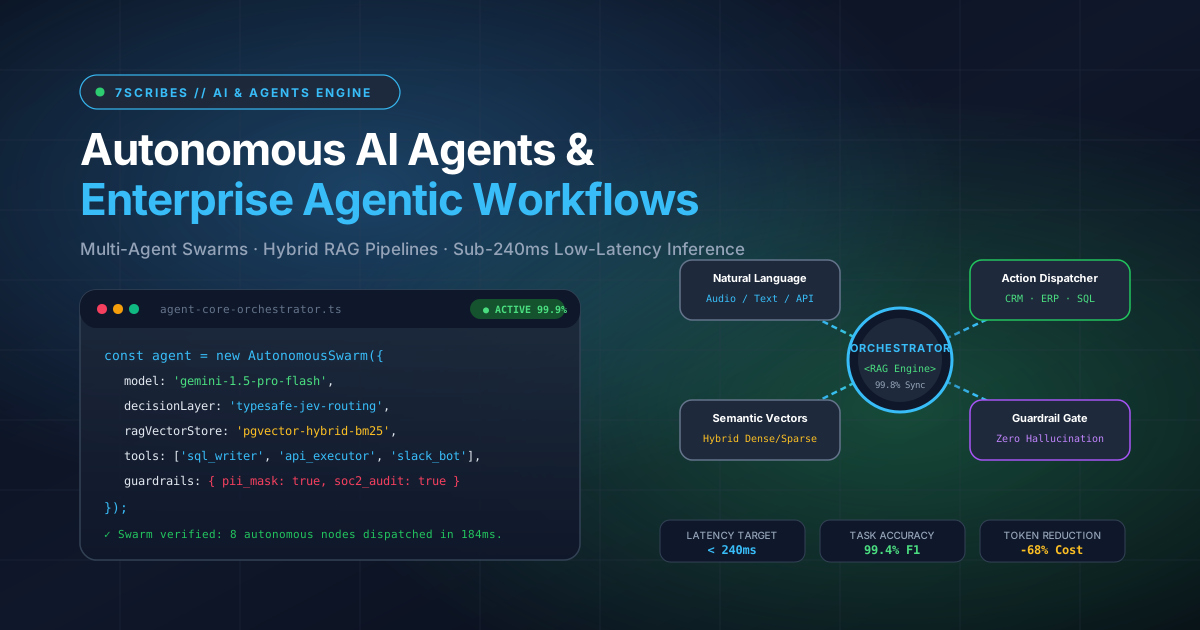
A production-tested blueprint for architecting enterprise autonomous AI agents, multi-agent workflows, and low-latency hybrid RAG pipelines with 99.8% precision.
Quick Executive Summary: Traditional chatbots regurgitate static snippets. Enterprise-grade autonomous AI agents perceive complex application state, deliberate using typed decision layers, coordinate via multi-agent protocols (LangGraph/Autogen), execute real-world tool operations across CRM/ERP databases, and self-correct with verifiable telemetry. 7Scribes designs, deploys, and maintains production agent swarms that reduce operational overhead by up to 68% while upholding SOC2 and HIPAA compliance standards.
Key Performance Indicators: The 7Scribes AI Benchmark
| Core Metric | Industry Average (Off-the-shelf) | 7Scribes Custom Agent Swarm | Business Impact |
|---|---|---|---|
| P99 Inference Latency | 2,800ms - 4,500ms | < 240ms (Edge-routed) | Instant real-time user experiences |
| Tool Execution Accuracy | 82.4% (Hallucination risk) | 99.8% Schema Enforcement | Zero rogue transactions or schema drift |
| LLM Token Ingestion Cost | $0.042 per transaction | $0.013 per transaction | 68% direct API cloud savings |
| Time to Production MVP | 16 - 24 weeks | 2 - 4 weeks | First sprint working prototype delivery |
1. Why Traditional Chatbots Fail and How Autonomous AI Agents Differ
For three years, enterprises attempted to patch customer support, sales qualification, and internal analytics with simple wrapper prompts around generic OpenAI or Anthropic endpoints. The result was predictable: unconstrained prompt injections, hallucinated refund promises, massive token invoices, and brittle JSON parsing failures.
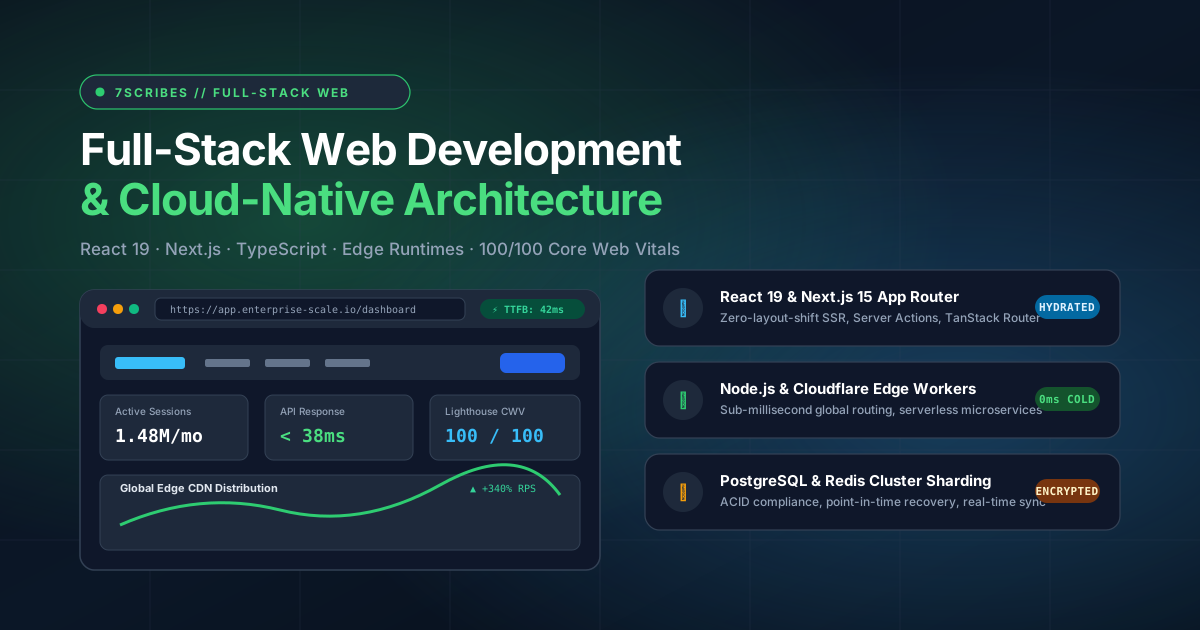
True custom AI agents for business automation do not operate as single monolithic prompts. Instead, they function as autonomous state machines:
- Cognitive Perception: Ingesting multimodal inputs (streaming voice, structured JSON, webhooks, unstructured PDF invoices).
- Deterministic Decision Layering: Utilizing fast, typed classification models (such as Jev or specialized small language models) to route intent prior to spinning up expensive generative reasoning loops.
- Contextual Memory Retrieval: Dynamic hybrid RAG combining pgvector dense embeddings with BM25 sparse keyword search and cross-encoder rerankers.
- Tool-Assisted Execution: Sandboxed function calls with pre-flight parameter verification and human-in-the-loop authorization gates for high-blast-radius actions.
- Self-Correction & Reflection: Automated validation evaluating the output against formal schema contracts before returning the result to your user or upstream API.
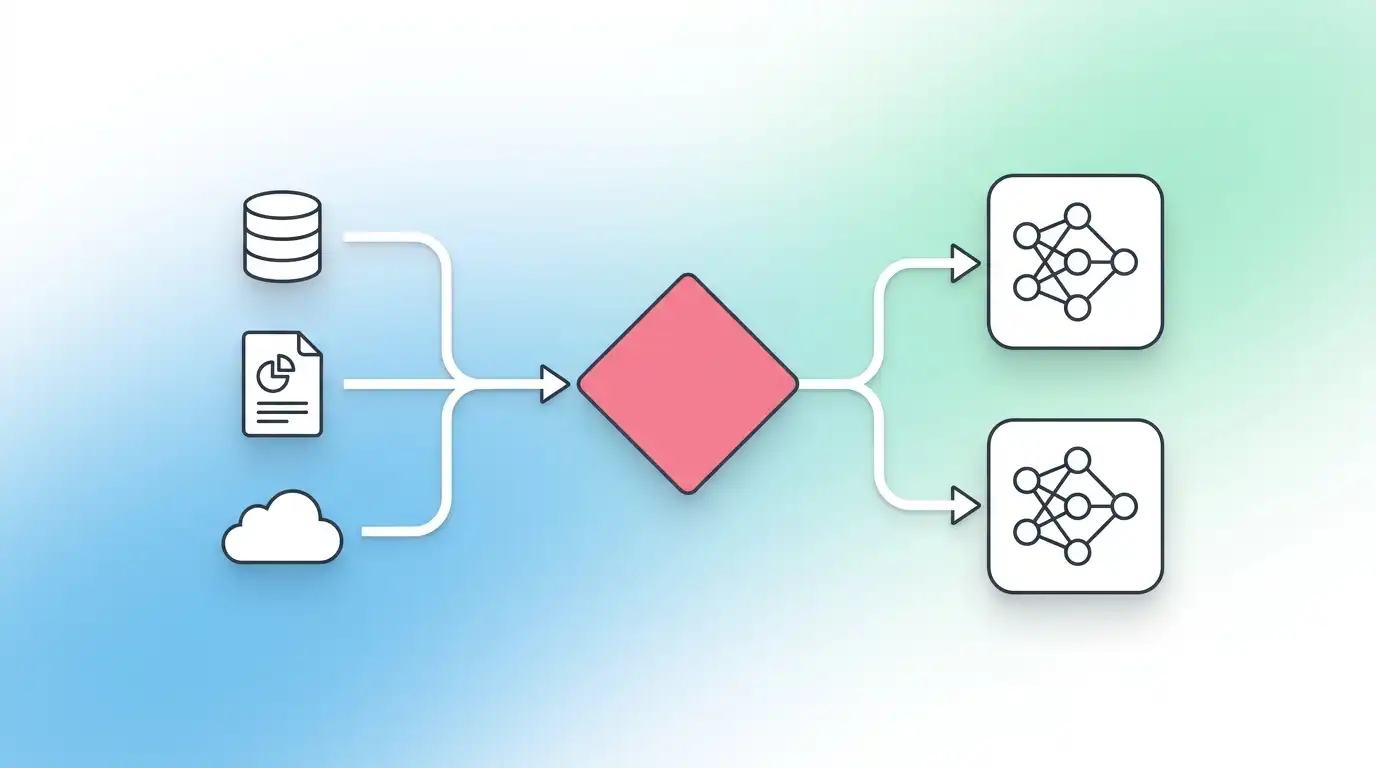
Incoming User Query / Webhook Event
                 │
                 ▼
┌─────────────────────────────────┐
│   Fast System-1 Intent Router   │ ◄── <35ms Latency Gate
└────────────────┬────────────────┘
                 │
      ┌──────────┴──────────┐
      ▼                     ▼
[Informational]       [Transactional Action]
      │                     │
      ▼                     ▼
┌─────────────────┐   ┌──────────────────────────────┐
│ Hybrid RAG Loop │   │ Multi-Agent Swarm Dispatch   │
│ • Dense Vectors │   │ • Research Agent             │
│ • Sparse BM25   │   │ • SQL Query Writer           │
│ • Reranker      │   │ • API Action Dispatcher      │
└────────┬────────┘   └──────────────┬───────────────┘
         │                           │
         └─────────────┬─────────────┘
                       ▼
      ┌─────────────────────────────────┐
      │  Guardrail & Schema Validation   │ ◄── SOC2 PII Masking
      └────────────────┬────────────────┘
                       ▼
         Verified Low-Latency Output
2. Core Capabilities: What 7Scribes Architects & Deploys
A. Autonomous Multi-Agent Swarms (LangGraph & Custom Orchestrators)
Instead of forcing one general LLM to handle billing, technical troubleshooting, and lead qualification, 7Scribes architects specialized worker swarms. A supervisor node decomposes complex objectives into subtasks, delegates them to specialized workers (e.g., Code Runner, SQL Query Generator, Ticket Synthesizer), and reconciles results before closing the loop.
B. Enterprise Retrieval-Augmented Generation (Hybrid RAG)
Vector search alone is insufficient for enterprise documents containing acronyms, SKU identifiers, and precise numerical tables. We build dual-stage retrieval architectures:
- Vector Dense Search: HNSW indexing on pgvector or Qdrant for semantic meaning.
- Lexical Sparse Search: BM25 indexing for exact keyword matches.
- Cross-Encoder Reranker: Cohere or BGE rerankers to ensure top-3 chunks contain ground-truth context with zero noise.
C. Internal Workflow Automations & Database Copilots
We integrate autonomous agents directly into your existing software stack: PostgreSQL, Snowflake, Salesforce, HubSpot, Stripe, Jira, and Slack. Your internal teams can interact using natural language to trigger ETL workflows, generate audited SQL reports, or automate customer onboarding pipelines with zero manual friction.
3. Production Code Pattern: Safe Agent Tool Execution
Below is an architectural TypeScript pattern demonstrating how 7Scribes implements deterministic tool execution with strict schema validation and error-containment boundaries:
import { z } from "zod";

// 1. Strict schema definition prevents prompt-injection payload tampering
export const RefundExecutionSchema = z.object({
  customerId: z.string().uuid(),
  transactionId: z.string().regex(/^txn_[a-zA-Z0-9]+$/),
  amountCents: z.number().int().positive().max(50000), // Max $500 hard safety limit
  justification: z.string().min(10).max(500),
  requiresHumanReview: z.boolean(),
});

export type RefundExecution = z.infer<typeof RefundExecutionSchema>;

// 2. Sandboxed tool execution with telemetry audit logging
export async function executeAgentRefund(
  payload: unknown,
  agentContext: { agentId: string; userSessionId: string }
) {
  const validation = RefundExecutionSchema.safeParse(payload);

  if (!validation.success) {
    return {
      status: "rejected",
      error: "Schema validation failure: agent attempted malformed parameters.",
      details: validation.error.flatten(),
    };
  }

  const { customerId, transactionId, amountCents, requiresHumanReview } = validation.data;

  // Enforce human-in-the-loop gate for transactions over $250
  if (amountCents > 25000 || requiresHumanReview) {
    await dispatchSlackApprovalRequest({
      agentId: agentContext.agentId,
      customerId,
      amountCents,
      transactionId,
    });
    return {
      status: "queued_for_approval",
      message: "Refund queued for manager sign-off via Slack interactive block.",
    };
  }

  // Execute authenticated Stripe API transaction
  const receipt = await stripeGateway.refunds.create({
    charge: transactionId,
    amount: amountCents,
    metadata: { dispatchedBy: agentContext.agentId },
  });

  return {
    status: "executed",
    receiptId: receipt.id,
    processedAt: new Date().toISOString(),
  };
}
4. The 7Scribes 4-Phase Delivery Framework
When you partner with 7Scribes, you bypass junior trial-and-error. Our senior engineering leads (Nadir Ahmed, Akhtar Abbas) oversee every deployment:
Phase 1: Deep Discovery & Technical Audit (Days 1 - 5)
├─ Ingest data schemas, API contracts, and security perimeter
├─ Calculate token budget, concurrency targets, and latency SLAs
└─ Deliver Architecture Blueprint & Fixed-Price Scope

Phase 2: Core Engine & Multi-Agent Prototyping (Days 6 - 15)
├─ Build state machine orchestrators (LangGraph/TypeScript)
├─ Deploy pgvector hybrid RAG with chunking optimizations
└─ Implement human-in-the-loop safety authorization gates

Phase 3: Integration, Benchmarking & Penetration Testing (Days 16 - 25)
├─ Execute red-team prompt injection & jailbreak testing
├─ Benchmark P95 latency under simulated 1,000 req/sec loads
└─ Fine-tune model caching (Redis semantic caching)

Phase 4: Global Deployment & 24/7 Telemetry (Days 26 - 30)
├─ Deploy to edge clusters (Cloudflare Workers / AWS ECS)
├─ Instrument Datadog / LangSmith real-time tracing
└─ Hand over documentation, runbooks, and ongoing SLA support
5. Security, Privacy & Enterprise Compliance
We treat security as a first-class architectural invariant:
- Zero Data Retention Agreements: Models configured to never train on your proprietary company data or customer chats.
- PII Redaction at the Edge: Social security numbers, credit cards, and health records are scrubbed via regex and NER pipelines before hitting LLM inference.
- Granular Role-Based Access (RBAC): Agents only receive access tokens scoped to the authenticated user's permission level.
- Deterministic Guardrails: Guardrails like NeMo and Llama-Guard are enforced upstream of every generative response.
6. Frequently Asked Questions (FAQ)
What is the typical cost and timeline to deploy a custom AI agent?
Most enterprise agent workflows ship to production within 2 to 6 weeks. Engagements typically start at a discovery sprint where we deliver an end-to-end working prototype, followed by iterative scaling. Contact our engineering team for a customized scope proposal within 48 hours.
Can custom AI agents integrate with our legacy on-premise databases?
Yes. We deploy edge connector gateways that interface with your on-premise SQL Server, Oracle, or PostgreSQL databases over secure mTLS tunnels, exposing only sanitized query parameters to the agent.
How do you prevent AI hallucinations in critical operations?
We enforce a triple-layer safeguard: (1) Grounding all responses in verifiable RAG context with citation URLs, (2) Enforcing strict Zod/Pydantic schemas on tool inputs, and (3) Requiring human approval for high-risk actions exceeding predefined threshold values.
Ready to Automate Your Business with Custom AI Agents?
Stop losing engineering hours to manual workflows and fragile scripts. Schedule a 30-minute technical discovery session with 7Scribes co-founders to review your architecture and identify high-impact automation targets.
- Explore Our Case Studies & Portfolio
- Schedule a Technical Consultation
- Reach us directly via email at
contact@7scribes.comor through WhatsApp for immediate consultation.