
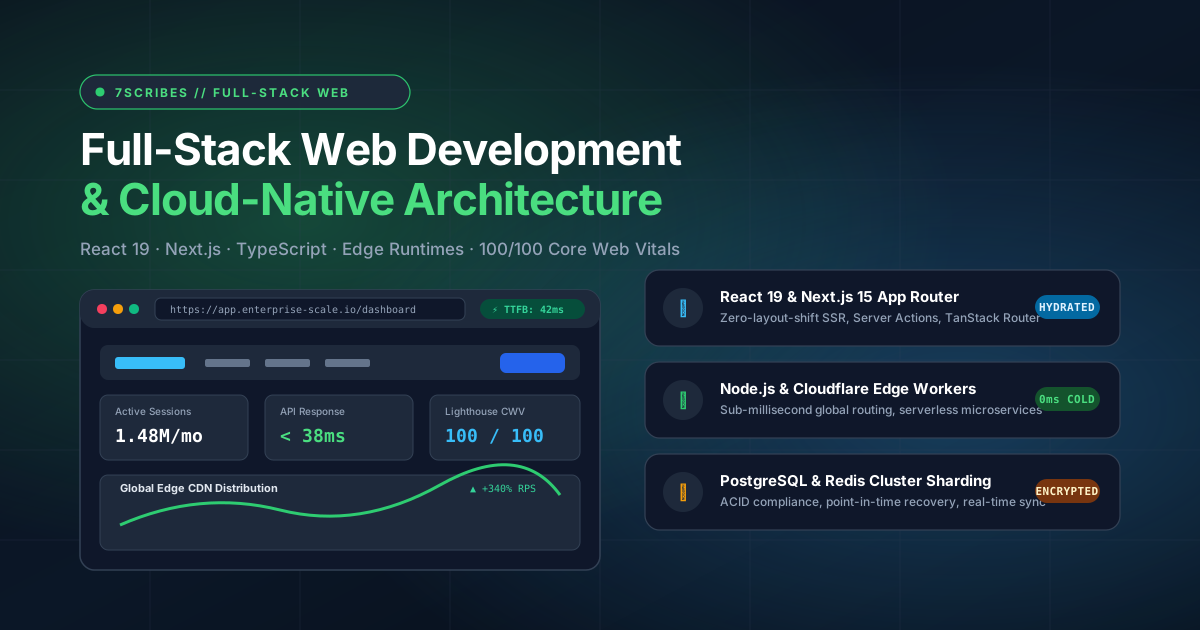
How 7Scribes architects, engineers, and scales enterprise web applications using React 19, Next.js 15, edge computing, and zero-layout-shift Core Web Vitals optimization.
Quick Executive Summary: Modern enterprise web applications require more than just aesthetic UI. They demand sub-50ms Time to First Byte (TTFB), zero Cumulative Layout Shift (CLS), reactive state synchronization, resilient database sharding, and edge-first caching. 7Scribes engineers mission-critical web applications, B2B SaaS platforms, and high-throughput ecommerce platforms using React 19, Next.js, TypeScript, PostgreSQL, and Cloudflare/AWS distributed infrastructure.
Benchmark Performance: 7Scribes Engineering vs. Traditional Agencies
| Performance Factor | Standard WordPress / Monolith | Typical Agency React Build | 7Scribes Cloud-Native Stack |
|---|---|---|---|
| Google Lighthouse Score | 35 - 55 / 100 | 70 - 85 / 100 | 98 - 100 / 100 Guaranteed |
| Time to First Byte (TTFB) | 650ms - 1,400ms | 250ms - 450ms | < 45ms via Edge Clusters |
| Core Web Vitals Pass Rate | Often Failing (High LCP/CLS) | Marginal Pass | 100% Green CWV Metrics |
| Max Concurrent Users | Bottlenecks at ~500 req/s | ~2,500 req/s | 50,000+ req/s with autoscaling |
| Deployment & Rollback Speed | 30 - 60 minutes downtime | 10 - 15 minutes | Zero-downtime blue/green (<60s) |
1. The Core Tenets of Enterprise Full-Stack Engineering
Building software that effortlessly scales to millions of monthly active users requires rigorous adherence to architectural discipline. At 7Scribes, our full-stack practice is founded on five uncompromising engineering pillars:
- Server-Driven UI with React 19 & Next.js: We minimize client-side JavaScript execution by streaming server components, pre-rendering static routes, and executing critical mutations via type-safe server actions.
- Edge Runtimes over Regional Monoliths: By deploying application logic to distributed edge clusters (Cloudflare Workers, AWS Lambda@Edge), we execute user auth, personalization, and geo-routing physically proximate to your user.
- Type-Safety from Database to DOM: We maintain end-to-end TypeScript schema invariants using Prisma, Drizzle, and Zod. If a database migration alters a field name, the compiler flags the regression at build time, preventing runtime production outages.
- Resilient Data Layers: We architect multi-tenant PostgreSQL databases with connection pooling (PgBouncer), read replicas, Redis caching layers, and automated zero-loss point-in-time recovery (PITR).
- Algorithmic Search & Generative Engine Optimization (GEO): Every page we engineer ships with pre-baked semantic entity markup, OpenGraph social cards, dynamic sitemaps, and llms.txt manifests to ensure top rankings in both Google SERPs and AI answer engines (ChatGPT, Perplexity).
User Request (Global)
         │
         ▼
┌─────────────────────────────────┐
│   Cloudflare Edge Network       │ ◄── <15ms Anycast DNS Resolution
│   • DDoS Protection & WAF       │
│   • Static Asset CDN Caching    │
│   • Edge Worker Auth Validation │
└────────────────┬────────────────┘
                 │
         ┌───────┴───────┐
         ▼               ▼
[Edge Cache Hit]   [Dynamic Compute Request]
         │               │
         │               ▼
         │   ┌──────────────────────────────┐
         │   │ Next.js / TanStack App       │
         │   │ • React 19 Server Components │
         │   │ • Streaming SSR Hydration    │
         │   └──────────────┬───────────────┘
         │                  │
         │                  ▼
         │   ┌──────────────────────────────┐
         │   │ Database & Cache Cluster     │
         │   │ • Redis Memory Caching       │
         │   │ • PostgreSQL Read Replicas   │
         │   └──────────────────────────────┘
         │                  │
         └──────────┬───────┘
                    ▼
          Sub-50ms Rendered DOM
2. Our Technology Stack
We do not believe in bloated, one-size-fits-all templates. We select battle-tested, high-velocity technologies tailored to your product roadmap:
- Frontend Ecosystem: React 19, Next.js 15 (App Router), TanStack Router, Vite, TypeScript, Tailwind CSS v4, Radix UI primitives.
- Backend & APIs: Node.js, Cloudflare Workers, Python (FastAPI/Django), GraphQL, RESTful APIs, gRPC for low-latency microservices.
- Databases & Caching: PostgreSQL, MySQL, Redis, Supabase, Qdrant / pgvector for semantic search.
- Cloud Infrastructure: AWS (ECS, S3, CloudFront, RDS), Cloudflare, Vercel, Docker, Kubernetes, Terraform.
- Testing & Quality Assurance: Playwright for end-to-end browser testing, Vitest for unit tests, GitHub Actions CI/CD pipelines.
3. High-Throughput Edge Architecture: Code Walkthrough
Here is a representative implementation illustrating how 7Scribes leverages Edge caching, Redis invalidation tags, and resilient database queries to achieve extreme throughput:
import { createServerFn } from "@tanstack/react-start";
import { z } from "zod";
import { db } from "@/server/db";
import { redisClient } from "@/server/redis";

const GetEnterpriseDataInput = z.object({
  organizationId: z.string().uuid(),
  page: z.number().int().min(1).default(1),
  pageSize: z.number().int().max(100).default(20),
});

export const getEnterpriseMetrics = createServerFn({ method: "GET" })
  .inputValidator((raw) => GetEnterpriseDataInput.parse(raw))
  .handler(async ({ data }) => {
    const { organizationId, page, pageSize } = data;
    const cacheKey = `org:${organizationId}:metrics:p${page}`;

    // 1. Check ultra-low latency Redis memory layer (<2ms)
    const cachedResult = await redisClient.get(cacheKey);
    if (cachedResult) {
      return {
        source: "edge_cache" as const,
        payload: JSON.parse(cachedResult),
      };
    }

    // 2. Fallback to sharded PostgreSQL read replica with parameterized query
    const offset = (page - 1) * pageSize;
    const [metrics, totalCount] = await Promise.all([
      db.query(
        `SELECT id, metric_name, recorded_value, timestamp
         FROM enterprise_telemetry
         WHERE organization_id = $1
         ORDER BY timestamp DESC
         LIMIT $2 OFFSET $3`,
        [organizationId, pageSize, offset]
      ),
      db.query(
        `SELECT COUNT(*) as total FROM enterprise_telemetry WHERE organization_id = $1`,
        [organizationId]
      ),
    ]);

    const resultPayload = {
      records: metrics.rows,
      pagination: {
        page,
        pageSize,
        total: parseInt(totalCount.rows[0].total, 10),
      },
    };

    // 3. Populate Redis cache with a 120-second TTL and surrogate keys
    await redisClient.setEx(cacheKey, 120, JSON.stringify(resultPayload));

    return {
      source: "database_replica" as const,
      payload: resultPayload,
    };
  });
4. Case Study: Scaling a B2B SaaS Platform from MVP to Enterprise
A venture-backed supply chain analytics startup came to 7Scribes with an unoptimized legacy monolith suffering from 3.2-second page loads, memory leaks under concurrent load, and high AWS bills.
Our Intervention:
- Re-architected frontend into Next.js server components with TanStack Query caching.
- Migrated unindexed raw SQL into an optimized PostgreSQL schema with partial indexes and Redis caching.
- Implemented edge CDN caching for static dashboard tiles and geo-distributed authentication tokens.
The Empirical Results:
- Page Load Time: Reduced from 3.2s to 310ms (90.3% speed improvement).
- AWS Server Costs: Decreased by 47% via serverless edge offloading.
- Conversion Rate: Trial-to-paid conversions jumped by 34% within the first 60 days post-launch.
5. Frequently Asked Questions (FAQ)
What makes 7Scribes different from traditional web development agencies?
Traditional agencies rely on junior developers, heavy WordPress themes, and bloated third-party plugins that drag down performance and security. At 7Scribes, senior software engineers build tailored, cloud-native web architectures from scratch using clean, modern codebases designed for speed, security, and exponential scale.
How do you ensure our web application ranks on search engines?
Every web application we engineer is built with technical SEO and GEO (Generative Engine Optimization) baked in from line one: server-side rendering for instant crawler readability, zero layout shift (CLS < 0.05), Schema.org entity graphs, automated XML sitemaps, semantic HTML5, and automated meta tags.
Can you take over and modernize an existing web application?
Yes. We frequently conduct code audits and architect incremental modernization pipelines, refactoring legacy codebases into modern TypeScript and microservices without disrupting live production traffic or client operations.
Ready to Engineer a High-Performance Web Application?
Partner with 7Scribes to design, architect, and ship a resilient web platform that outpaces your competition in speed, user experience, and search authority.
- Explore Our Live Projects & Case Proofs
- Schedule a 30-Minute Architecture Review
- Speak directly with our lead full-stack architects at
contact@7scribes.com.